An article in the Volume 22, No. 1, Spring 2010 issue of Behavior Analysis Digest International describes a service delivery model in which the hiring of Board Certified Behavior Analysts® as full-time employees of school districts, rather than on a contract basis for the equivalent services, resulted in substantial cost savings. The article is reprinted in its entirety, and any changes are purely for typesetting purposes.
" School districts Hire Behavior Analysts, Save Money - Lots of Money.
Eric Burkholder, Dublin Unified School District; Chelsea J. Wilhite, University of Nevada, Reno; Rebecca Peck, Livermore Unified School District; Carla A. Epps, and Julia H. Fiebig, San Ramon Valley Unified School District; Lorien Quirk and Joel Vidovic, Mount Diablo Unified School District.
San Francisco - In the current financial climate, states are cutting funding to public school districts. Districts are investigating service delivery models in attempts to determine cost-effective ways to provide services to students, including those eligible for special education. School districts' critical examination of costs extends to services historically provided by behaviorally-oriented, non-public agencies. Now some California districts have hired board certified behavior analysts to provide behavior analytic services as full-time district employees, rather than contracting the same service, and money is being saved.
The addition of a full-time behavior analyst as a school district employee can have many impacts on the service delivery system within a school district. The impact of having an in-house behavior analyst may increase staff ability to manage students' behaviors, increase capacity to serve students with autism and other disorders and allow better service delivery of services using scientifically validated techniques and it saves cash. Three school districts in California have found that the addition of full-time behavior analysts is a cost effective approach to delivering these services.
The three suburban school districts are located in California's San Francisco Bay Area. Dublin United States School District, Mount Diablo Unified School District and San Ramon Valley Unified School District. All three, prior to hiring behavior analysts, had significant expenditures for behavioral consultants and behavioral non-public agencies that serve special education students. The services took several forms, including individualized consultation services written into students' IEPs, class-wide consultation as part of ongoing service delivery, individual educational evaluations and staff training. As part of cost control and quality control all three schools decided to hire board certified behavior analysts (BCBA's) full-time.
All three school districts reported an average reduction in costs compared to when they had contracted behavioral services: $244,108 per behavior analyst hired! "
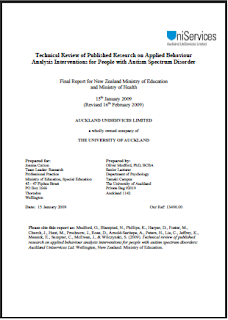
Mudford, O., Blampied, N., Phillips, K., Harper, D., Foster, M., Church, J., Hunt, M., Prochnow, J., Rose, D., Arnold-Saritepe, A., Peters, H., Lie, C., Jeffrey, K., Messick, E., Sumpter, C., McEwan, J., & Wilczynski, S. (2009). Technical review of published research on applied behaviour analysis interventions for people with autism spectrum disorders: Auckland Uniservices Ltd. Wellington, New Zealand: Ministry of Education.
Those interested in the report are directed to the Executive Summary page, where that summary and the full 126 page report can be directly accessed, respecting the note,
"Reports from Auckland UniServices Limited should only be used for the purposes for which
they were commissioned. If it is proposed to use a report prepared by Auckland UniServices
Limited for a different purpose or in a different context from that intended at the time of
commissioning the work, then UniServices should be consulted to verify whether the report is
being correctly interpreted. In particular it is requested that, where quoted, conclusions given
in UniServices reports should be stated in full."
For further information "Technical Review of Published Research on Applied Behaviour Analysis Interventions for People with Autism Spectrum Disorder"
Executive Summary and links to full report
Education Counts Author: Mudford, O., Blampied, N., Phillips, K., Harper, D., Foster, M., Church, J., Hunt, M., Prochnow, J., Rose, D., Arnold-Saritepe, A., Peters, H., Lie, C., Jeffrey, K., Messick, E., Sumpter, C., McEwan, J., & Wilczynski, S. (2009).
Date Published: 15 January 2009 - Revised 16 January 2009
Released on Education Counts: April 2010
On April 15, 2010 the the Healthy Families and Communities Subcommittee of the U.S. House Committee on Education & Labor heard testimony on the topic of
"...Research notes that corporal punishment [defined as the intentional application of physical pain as a method of behavior change - see testimony for specific named practices and citations] constructs an environment of education that can be described as unproductive, nullifying, and punitive. Children become victims, and trepidation is introduced to all in such a classroom. There is a limited (if any) sense of confidence and security; even those children who witness this type of abuse are robbed of their full learning potential... It is critical that teachers receive adequate training and resources to help them effectively maintain classroom control without resorting to violent or aggressive techniques.2 One way to accomplish this is to provide teachers, both during pre-service and in-service training, with the ability to employ behavior management techniques that promote pro-social classroom interactions among the students; this would also promote a positive learning environment for those students..."
It is reported that currently there is no U.S. federal regulation on corporal punishment in schools although thirty states have prohibited the practice. The twenty remaining states are primarily in the South. A recent Washington Post article reports that the Chairperson of the Subcommittee, Representative Carolyn McCarthy, plans to introduce in a matter of weeks a resolution to ban the use of corporal punishment in U.S. Schools.
Among the citations and references supplied to the Subcommittee by Dr. Greydanus were,
The state of West Virginia may be in line to almost double the number of BACB certificants above the state's current number of nine when West Virginia University (WVU) graduates its first class from the Behavior Analysis for Teachers program in the summer of 2010.
This collaborative project between Monongalia Couny Schools and WVU aims to provide working teachers with graduate level training in behavior management principles and strategies and qualify them at completion to to sit for Behavior Analyst Certification Board examination, either at the Board Certified Behavior Analyst (BCBA) or Board Certified Assistant Behavior Analyst (BCaBA) level; the program is unique in that the instructors go to the enrolled students rather than a typical university enrollment model. The focus of training is core behavioral principles and those related to the classroom - such as Functional Behavior Assessments and applying that information to the development of function-based interventions for students.
The first class of eight Monongalia County teachers began program in the summer of 2009 and at completion in the summer of 2010 will have gone through four semesters of graduate-level academic training and a year-long supervised practicum.
While the program is potentially open to all teachers in the Monongalia County Schools, only top candidates from competitive application are chosen for admission.
The Progress (NJ) reports that Caldwell College was recently awarded over half a million dollars in federal funding for the Applied Behavior Analysis program, which currently offers a Post-Baccalaureate Certificate, an M.A. program, and a new Ph.D. program. The funding was obtained with the help of New Jersey Congressman Rodney Frelinghuysen, who worked with Sharon A. Reeve, Ph.D., BCBA, Caldwell's Program Coordinator of Graduate Studies in Applied Behavior Analysis, to approach U.S. Senators Frank R. Lautenberg and Robert Menendez for support of the new program.
Senator Lautenberg has assisted the program in the past by securing federal funding to help to support the startup of Caldwell's ABA doctoral program.
The college plans to begin construction this summer for an on campus facility for the ABA program; it will serve as a center for workshops and programs for K-12 teachers and parents.
This 732 page document lists numbers and trends related to those enrolled and employed in education - preschool through graduate school.
"The 45th in a series of publications initiated in 1962, the Digest's primary purpose is to provide a compilation of statistical information covering the broad field of American education from prekindergarten through graduate school. The Digest contains data on a variety of topics, including the number of schools and colleges, teachers, enrollments, and graduates, in addition to educational attainment, finances, and federal funds for education, libraries, and international comparisons."
The two bills that would establish Federal regulation of the use of restraint and seclusion in U.S. Schools and their prohibition in Individualized Education Plans (IEPs), are currently in the U.S. Senate Committee on Health, Education, Labor, & Pensions (HELP). The House Committee on Education and Labor is examining the use of corporal punishment in schools and the effect on academic achievement.
With the Senate returning from its 2-week break, advocacy groups have begun "phone-in" days for S. 2860, urging Committee action for passage in the current Congress.
On a related note, the House Committee on Education and Labor will be holding a Healthy Families and Communities Subcommittee meeting on Thursday, April 15, 2010, 10:00 AM, 2175 Rayburn H.O.B Washington, DC. Witness to be announced.
Both Committees are also actively taking testimony in the overhaul and re-authorization of the Elementary and Secondary Education Act (ESEA), currently known as "No Child Left Behind".
Three years after being hired by the Norwalk School District, Norwalk, Connecticut to provide behavior analysis services to its students with autism, Stacy Lore, who operated a business called Spectrum Kids, LLC, is being held under $200,000 bond after multiple indictments for forgery, larceny and criminal impersonation. Ms. Lore is accused of falsely representing herself as holding a Doctorate in Psychology and certification by the Behavior Analyst Certification Board to the Norwalk School Board, which on that basis contracted her services in March of 2007; Ms. Lore was also contracting out her services on a private-pay basis to local families, and to other Connecticut and New York School districts. By August of 2008 multiple complaints related to accounting, service delivery, professional behavior, and lack of progress and regression in some children was reported, leading parents within the district to demand investigation and action. Even after receiving notification from the BACB that Ms. Lore was not a BACB certificant, the district did not immediately terminate her contract resulting in parents to eventually direct their inquiries to the state Attorney General and file Freedom of Information Act (FOIA) requests to discover the extent of background checking that was done before Ms. Lore's hire.
The case involving Ms. Lore bears similarity to that of the 2006 case of Nancie Fisher in New Jersey, who also claimed false credentials and was indicted and eventually convicted of fraud involving over $200,000.
Connecticut H.B. 5425: AN ACT CONCERNING SPECIAL EDUCATION.
To reconstitute the State Advisory Council for Special Education by reducing the number of members to make it consistent with federal law; to require boards of education to provide applied behavior analysis services to certain special education students; to establish that the burden of proof lies with the party requesting a special education hearing; and to require the school district from which a child transfers to pay for such child's special education costs for the remainder of the school year.
Amendments appear to be most pertinent to certain structural changes to the proposed Advisory Council for Special Education, and financial responsibility for special education students who change districts or commence special education services after the start of the school year.
Currently there are two similar bills in the Oklahoma Legislature which would establish scholarships allowing private school choice for students on IEPs. The two bills are,
Committee substitute for House Bill 3393: Developmental disabilities; modifying the Self-Directed Care Pilot Program; creating the Scholarships for Students with Disabilities Program; codification; effective date; emergency.
The committee substitute for House Bill 3393 would establish the Scholarships for Students with Disabilities Program for the purpose of providing a scholarship to a private school of choice for students with disabilities who have had an individualized education program (IEP) developed in accordance with the Individuals with Disabilities Education Act.
The measure specifies criteria that must be met for the student to receive a scholarship and directs the State Department of Education to approve a private school as eligible to participate in the program based on specified criteria. The bill also provides that, beginning with the 2010-2011 school year, a school district may satisfy its duty to provide special education and related services for children with disabilities by providing a scholarship at the request of a parent for a child to attend a private school or by transferring the child to another school district upon written request by the parent and approval of the receiving district.
HB 3393 would also amend the Self-Directed Care Pilot Program administered through the Oklahoma Department of Human Services by expanding the program statewide and changing its status from pilot to permanent; under the program, individuals with developmental disabilities are given a budget allowance in which they direct services rather than a third party. This creates a saving that is shared by the individuals directing and receiving the service and with the Department of Human Services.
A similar bill, which has a similar scholarship condition without addressing the Self-Directed Care Pilot Program is,
House Bill 3327: Schools; creating the Scholarships for Students with Disabilities Program; codification; effective date; emergency.
An Act relating to schools; amending 70 O.S. 2001, Section 13-101, which relates to special education services for children with disabilities; authorizing districts to provide scholarship for certain students to attend certain institutions; creating the Scholarships for Students with Disabilities Program; stating intent; specifying procedures; establishing eligibility requirements; establishing formula for maximum scholarship amount; clarifying school districts not responsible for additional costs; precluding liability; providing for codification; providing an effective date; and declaring an emergency.
HB 3327 referred to the House Appropriations and Budget Committee on February 2, 2010 and is currently noted as "dormant" at the legislative website.
Executive Summary (February 2008) Self-Directed Services (SDS) Pilot Program Evaluation Report This report was developed through a collaborative project of the Oklahoma Department of Human Services (OKDHS) and the Center for Learning and Leadership/Oklahoma UCEDD at the University of Oklahoma Health Sciences Center, College of Medicine.
Call for Public Comment through May 31, 2010: Principles for Quality Undergraduate Education in Psychology
-----------------------------
"The APA Board of Educational Affairs (BEA) has posted the Principles for Quality Undergraduate Education in Psychology (Draft, January 2010) for review and comment. These recommendations were developed following the 2008 APA National Conference on Undergraduate Education in Psychology.
In accordance with Association Rule 30-8, BEA is circulating the Principles for Quality Undergraduate Education in Psychology to APA governance groups, APA Divisions, State Psychological Associations, other organizations in psychology, departments and schools of psychology, and members of the public.
Feedback will be gathered through May 31, 2010. At the conclusion of public comment, the document will be circulated to all APA governance groups with a request that the Council of Representatives approve as Association policy the Principles for Quality Undergraduate Education in Psychology.
In order to submit comments, participants must first register. Registration requires participants to use an email address, and to develop a password.
Select the Principles for Quality Undergraduate Education in Psychology from the list of projects to view instructions, register, and to post comments. To submit feedback, please select "edit comments."
Comments may be submitted through May 31, 2010.
If you have any questions, contact Robin Hailstorks, PhD (RHailstorks@apa.org) or
Martha Boenau (MBoenau@apa.org) at 202-336-6140.
Martha Boenau | Associate Director, Office of Precollege and Undergraduate Programs
Progress of H.R. 4247 is dependent on what action is taken in the House, but it has been anticipated that if it passes in that chamber, that a conference committee would work to consolidate proposals within H.R. 4247 and those within S. 2860: Preventing Harmful Restraint and Seclusion in Schools Act, which was introduced in the U.S. Senate and is currently in the Senate Committee on Health, Education, Labor, and Pensions.
Inside Behavior Analysis
Volume 1 | 2009 | Number 2 | On-line ISSN: 2151-4704 ABAI Practice Board
(About 3/4 of the way down the page.)
"Position Statements
The ABAI Council assembles task forces to study critical issues within the field and to develop white papers for submittal to the Association' s Full Members for input and votes. Most recently, a task force on seclusion and restraint has been formed, with joint participation of the Science and Practice Boards. The task force will develop and recommend a position statement on the appropriate use of seclusion and restraint for consideration by ABAI Full Members. Participants in the task force include Jon Bailey, Michael F. Dorsey, Louis P. Hagopian, Gregory P. Hanley, David B. Lennox, Mary M. Riordan, Scott Spreat, and Timothy R. Vollmer. "
Changes to federal financing formulas with emphasis on school performance
Changes to education law
Elimination of the requirement deadline of 2014 to have all students be proficient, to be replaced by graduation from high school, "college or career ready",
Possible elimination of school ratings systems based on making "adequate yearly progress" on student test scores.
Regarding new systems, proposals are
Dividing schools into more categories to give recognition for success and increasing funding for improvement or closure of failing schools.
Define learning goals in earlier grades
One proposal is that based on the results of programs such as the Race to the Top Fund, that similar strategies and conditions might be applied to the distribution of funding through the U.S. Department of Education so that the emphasis is on improvement of schools.
Such proposed changes to educational law would be subject to Congressional approval, and the Administration is reported to be soliciting input from Congressional leaders of both parties in coming weeks to create legislative language attractive to bipartisan support.
"...That's why I've proposed a more than 6 percent increase in funding for the Education Department. And this funding is tied to reforms that raise student achievement, inspire students to excel in math and science, and turn around failing schools which consign too many young people to a lesser future -- because in the 21st century there is no better anti-poverty program than a world-class education..."
A collaboration of The Maine Department of Health and Human Service & The Maine Department of Education recently issued an evaluative report of research evidence for various interventions for autism spectrum disorders.
A helpful discussion of evidence and summary table can be found on pages 8-10
The Winter 2010 issue/volume 7(1) of Science in Autism Treatment, the newsletter of the Association for Science in Autism Treatment contains a useful summary and discussion on the Maine report,
Myers, S.M., Plauche Johnson, C., (2007). Clinical report: Management of children with autism spectrum disorders.Pediatrics, 120(5),1162-1182. (doi:10.1542/peds.2007-2362) AAP Policy - American Academy of Pediatrics NB: Applied behavior analysis and functional behavior analysis covered under "Specific Strategies" on page 1164, under "Speech and Language Therapy" on page 1165, under "Social Skills Training" on page 1165, under "Comparative Efficacy of Educational Interventions for Young Children" on page 1166, under "Programs for Older Children and Adolescents" on page 1166.
RELATED PRESENTATIONS, GROUPS, BOOKS & POSTS AUTISM
Presentation: 7. Behavior Analytic Research in the Treatment of Autism David Celiberti, Ph.D., BCBA "An overview of the state of research in autism that evaluates behavior analytic and non–behavior analytic treatments will be presented, with an emphasis on considerations for future research in applied settings." Presented Monday August 4 at the 2008 National Autism Conference. August 4–8, 2008 Penn State, Pennsylvania (scroll down the page to the presentation, handouts, and audio of the presentation)
Effective Practices for children with autism: Educational and behavior support interventions that work. (2008). New York: Luiselli, J.K., Russo, D.C., Christian, C.P, & Wilczynski, S.M. (Editors). New York: Oxford University Press, USA. ISBN-13: 978-0-19-531704-6 [Google books limited preview]
Early intervention for autism spectrum disorders: a critical analysis. Matson, J.L., & Minshawi, N.F. (2006). Amsterdam: Elsevier Ltd. ISBN-13: 978-0-08-044675-2 [Google books limited preview]
The National Standards Project of the National Autism Center announced in their December newsletter that a NEW manual targeting educators is available for free download or purchase at their website, and shared an update on the also available recently released National Standards Project Report.
National Autism Center Releases New Autism Educator Manual
"We are pleased to make available a comprehensive new manual by the National Autism Center entitled, Evidence-Based Practice and Autism in the Schools.
'We created this manual for educators as a means of promoting evidence-based practice for Autism Spectrum Disorders (ASD) in schools,' said Susan M. Wilczynski, Ph.D., BCBA, Executive Director of the National Autism Center. 'We know that research-supported interventions are most likely to produce positive outcomes for the ever-increasing numbers of students with ASD.'
The development and publication of the manuals were made possible through support from the American Legion Child Welfare Foundation, Inc., and the Niel M. Wreidt 2003 Revocable Trust. The American Legion grant enabled us to distribute the first 3,000 manuals free of charge to public school systems throughout the country.
Due to the overwhelming response to the manuals, we are making them available on our website. Visitors can now download them for free, or purchase a hard copy through our on-line Bookstore. We welcome you to take a look!"
This new manual is a complement to the National Standards Project Report, previously issued in September, which addressed the level of evidence for autism interventions.
In their update on the National Standards Project Report, the NAC December newsletter also stated that,
"The response to our September announcement of National Standards Project results has been tremendous! Individuals from every state in the United States, and from close to 50 countries, have visited our website in the past two months. They have downloaded tens of thousands of free copies of the Project results.
Help us to continue spreading the word! Forward our e-card to others who might be interested in learning about the National Standards Project.
We invite you to visit our website to view and download a free electronic copy, or to purchase a printed copy, of the report.
The primary goal of the National Standards Project is to provide critical information about which treatments have been shown to be effective for individuals with Autism Spectrum Disorders. The National Standards Report covers a broad range of applied treatments and identifies the level of scientific evidence available for each. The report serves as a single, authoritative source of guidance for parents, caregivers, educators, and service providers as they make informed treatment decisions. We are confident that these findings and recommendations will change lives and give hope and direction to people whose lives are touched by autism."
2010 Regina G. Claypool-Frey Disclaimer: This blog publishes news and announcements only as a service to interested persons, the posts are the responsibility of the individual author, and unless otherwise noted do not constitute nor claim to represent the official position of ABA International, its officers or associated entities. This blog makes no representation as to the accuracy of the report and readers are strongly encouraged to consult and reference the primary sources noted.